08/06/26
Expert opinion
SCORM vs xAPI: Which Standard to Choose for Your Digital Training

Turnover is the single biggest operational challenge most hotel groups face. Staff arrive, start the job, and sometimes leave within the first few weeks. Onboarding is part of the answer, but it is rarely where the problem sits. The gap opens when the structured training ends and the employee is left to figure out the rest from the operational rhythm alone.
Closing that gap takes training designed as a learning path, not a one-shot module. At Accor, Pascaline Hazart has been explicit that the most effective way the group has found to create retention on the long run is to build real development paths that span months, not hours. This is the discipline behind the 3D SOP Game Emeraude Escape designed with Accor, where 87% of learners gave the highest possible satisfaction score across a multi-chapter journey.
Onboarding gets disproportionate attention because it is the easiest part of the employee journey to redesign. It has a clear start, a clear end, and a measurable completion rate.
The trouble is what comes next. Onboarding ends, and the next structured training event is often a compliance refresh months later. In between, the learner is expected to grow on the job, inside the operational rhythm, with little designed support. For a new joiner in hospitality, that silence lands at the worst possible moment. The early weeks are when most turnover decisions are made, and the employee is asking a very simple question: is there a path here, or am I just filling a shift?
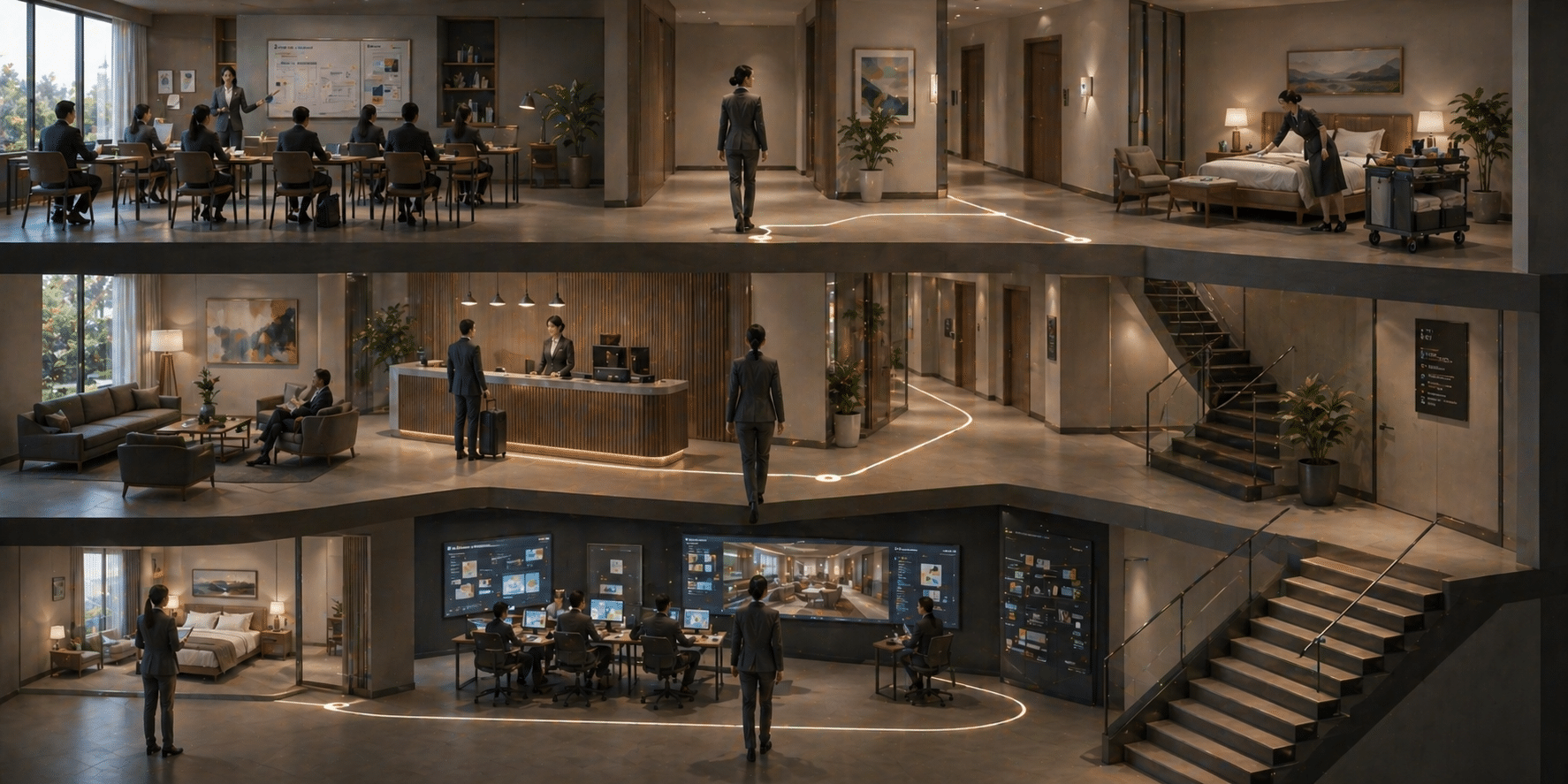
At Accor, the answer is a three-phase path that starts at onboarding and extends across the first months on the job. The first phase is the onboarding path itself, spanning one to three months rather than a single week, so the new joiner is carried past the initial settling-in and into real operational confidence. The second phase is skill development, where the employee grows inside their role and sees their performance improve. The third phase is career building, where the path opens into the next role in the hotel or the group.
The effect on the employee is not subtle. They see themselves on a trajectory. Working at the hotel becomes a learning journey rather than a rota of shifts, and the retention case makes itself.
The design implication is significant. Training is no longer a library of one-hour modules. It is a sequence of experiences that connect, with a shape the learner can feel.
Long-form paths in hospitality cannot be fully digital. Not every role has a laptop, language coverage is uneven across a global network, and the job itself is hands-on. Accor runs on a hybrid model combining digital gamified experiences, live workshops and classroom sessions, and on-the-job mentoring, which also keeps the path varied enough that the learner never walks into a room expecting to repeat what they did last time. Each training is a new experience in itself.
The digital layer has to do real work inside that blend. In the 3D SOP Game, it carries the scenario-based rehearsal of operational and guest moments, and it is designed to be played solo or in a live classroom session, so the digital experience and the facilitated one can share a room when useful.
The reward layer in most gamified training is static. Same badges, same point system, same leaderboard from week one to the end. After a few weeks, the rewards stop meaning anything.
Inside a long-form path, rewards have to stay connected to what the learner is actually doing. The scoring system compounds across chapters, so consistency is rewarded, not just completion. Certificates are only unlocked above an 80% success threshold, which keeps the standard visible. The leaderboard operates at three levels (individual, hotel, region), so the learner sees themselves in a collective, not just against an abstract benchmark. A secret room, unlocked by collecting a fragment of a magnetic key inside each chapter, gives the whole arc a destination.
Each of these is doing pedagogical work. Together they turn a multi-chapter training into a path with its own momentum.
Operational training without a story is a checklist. A checklist can be completed. It cannot be returned to.
In hospitality, the narrative is almost always carried by the brand. A receptionist learning the standards of a midscale brand is not just learning procedures. They are learning what it means to deliver the version of hospitality that brand stands for. When the storytelling is done well, the brand becomes the through-line of the training, and the learner becomes part of it.
At Accor, that storytelling is anchored in the Heartist® culture, where “Heartist” combines the heart staff put into their work with the artistry that defines the craft of hospitality. A 12-hour gamified path anchored in that culture is not a training calendar. It is a version of the employee story the new joiner can see themselves inside.
Accor partnered with Emeraude Escape to design a long-form learning experience covering four job families across economy, midscale and premium brands. The build was structured as three chapters with a scoring system that compounded across the arc, a country-level hotel leaderboard, a certificate gated above 80% success, and a secret room accessible only to learners who completed every mission.
Sequencing introduced operational fundamentals first, then layered brand-specific variations across Ibis, Ibis Styles, Novotel and Pullman. The reward system evolved across chapters. Brand storytelling was anchored in Accor’s Heartist® culture, and general managers from several countries were involved throughout the build to make sure the training reflected the reality of their hotels.
Engagement held across the full arc. 87% of learners gave the highest possible satisfaction score, with detailed questions averaging above 4.5 out of 5. The training was deployed in 20 languages and integrated with Accor’s Docebo LMS, with weekly reporting feeding continuous refinement after launch.
Long-form training costs more and takes longer to build than short modules. The return shows up in the metric hotel group leadership cares about most: whether staff stay past the early months and continue to grow inside the network. When training is designed as a real development path, with real sequencing, hybrid delivery, rewards tied to the path, and brand storytelling that gives the journey weight, it becomes one of the few L&D investments that directly shapes retention. The design discipline required is specific. Explore how Emeraude Escape approaches long-form gamified learning on our Learning & Development solutions page.
Get a personalized demonstration by one of our game design experts.



Mystery game
Congrats!
An error has occurred
Welcome {name}
Keep an eye on your email {email}, you will receive something from us in the next few hours.