08/06/26
Expert opinion
SCORM vs xAPI: Which Standard to Choose for Your Digital Training
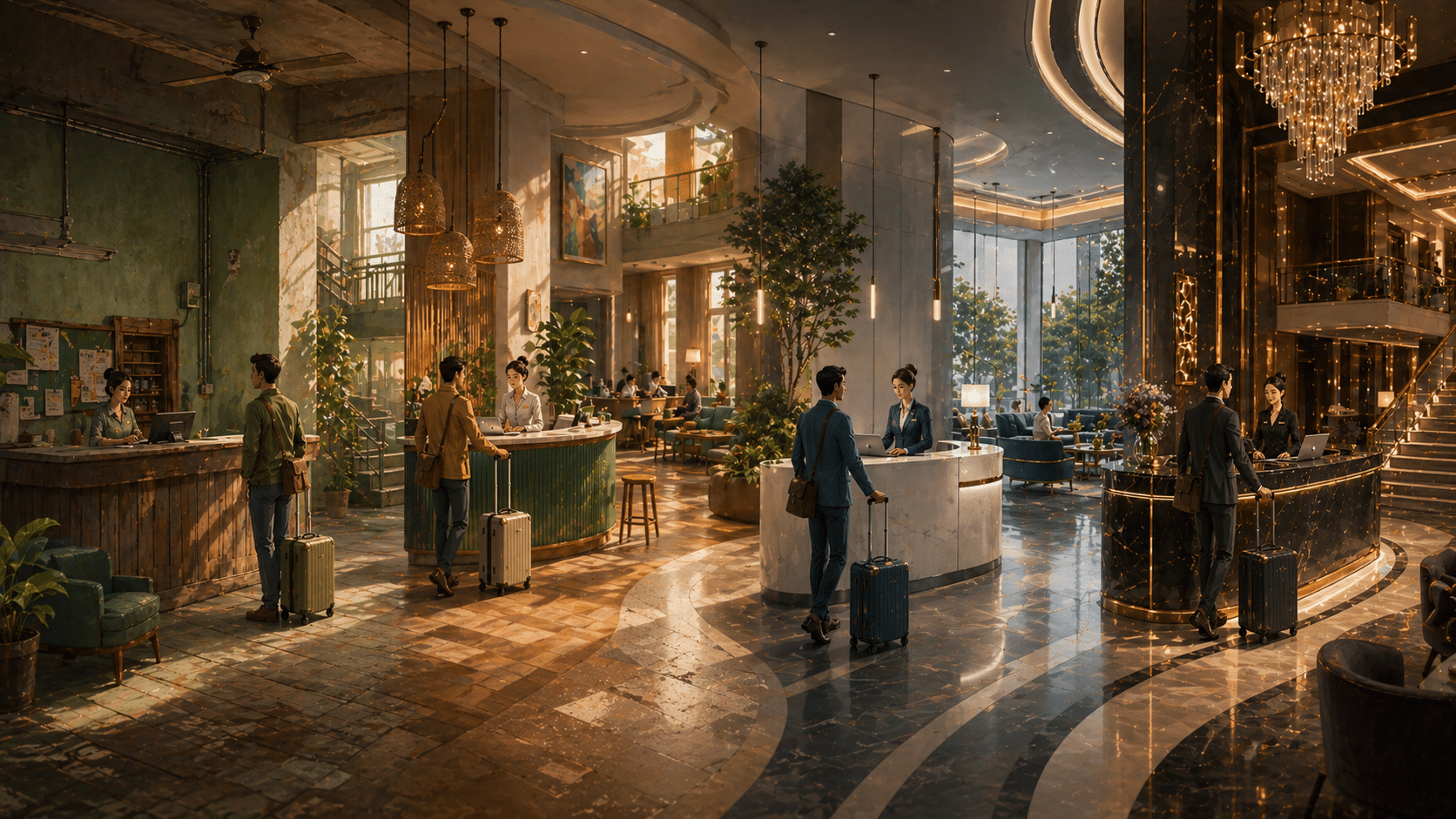
Multi-brand hotel groups operate on a tension most training programs fail to resolve. Every brand in the portfolio has its own service codes, its own visual identity, and its own version of what good hospitality looks and feels like. A receptionist at an economy brand and a receptionist at a premium brand share the same job title, but the way they welcome and serve a guest is not the same.
Brand-led hospitality training has to carry that distinction, or it will be ignored on the floor. This is not a translation problem or a template problem. It is a design and production challenge: building a single training architecture where each brand lives in its own immersive world, while sharing the same underlying engine. It is the challenge Emeraude Escape solved with Accor across four brand segments and 20 languages.
Accor has moved toward a brand-led organisation, which means more emphasis on brand-specific topics inside training, not less. The service culture trainings the group relaunched in 2025 are explicit about this: the way a guest is welcomed at Ibis is not the way a guest is welcomed at Novotel.
The conventional response is to build separate programs per brand. The result is fragmented architecture, inconsistent pedagogy, and a growing maintenance burden as each brand’s training drifts in its own direction. After two or three years, the programs share nothing but a logo on the login screen.
The actual design problem is more specific: how to build a shared pedagogical engine rigorous enough to hold consistent standards, while layering brand-specific worlds on top detailed enough for staff to recognise their own workplace inside the training.
Solving this requires splitting the build into two layers that evolve independently.
The engine layer holds everything that should be consistent across brands: the gameplay mechanics, the scoring system, the pedagogical structure, the chapter sequencing, the assessment logic, the LMS integration. This layer is brand-agnostic. It defines how the training works.
The world layer holds everything that should be distinct: the 3D environments, the visual identity, the service scenarios, the guest profiles, the tone of the interactions, the atmosphere of the spaces. This layer is brand-specific. It defines how the training feels.
Separating the two is what makes the architecture scalable. Adding a new brand to the engine does not require rebuilding the pedagogy. It requires building a new world on top of it.
A 3D training environment is not a reskin. Changing the colour palette and swapping a logo does not make an economy hotel feel like an economy hotel. The difference between brands lives in texture, materials, lighting, uniform and spatial detail.
Building at this fidelity takes close work with the brand and marketing teams from the first sprint, not the last review. They are the ones who know what a Pullman lobby feels like versus a Novotel lobby, what the uniform communicates, what the signage standards are, what a family-focused Novotel breakfast area should include (a kids’ corner, a lower table, a waffle maker) versus what a premium Pullman space should look like. Smaller decisions matter too: the phone on the front desk needs to be cordless, not corded, because the corded version feels outdated on screen. Every small detail the learner recognises pulls them closer to their actual hotel.
For a brand like Ibis Styles, where no two hotels look alike, a design stance has to be taken. In the Accor project, that meant choosing one direction, the disco theme, and committing to it. A training cannot represent every property, but it can commit clearly enough that a staff member working at an Ibis Styles hotel sees the spirit of their brand on screen.
When this work is done well, staff open the training and feel at home. That recognition is pedagogical. It removes the distance between the training environment and the real one.
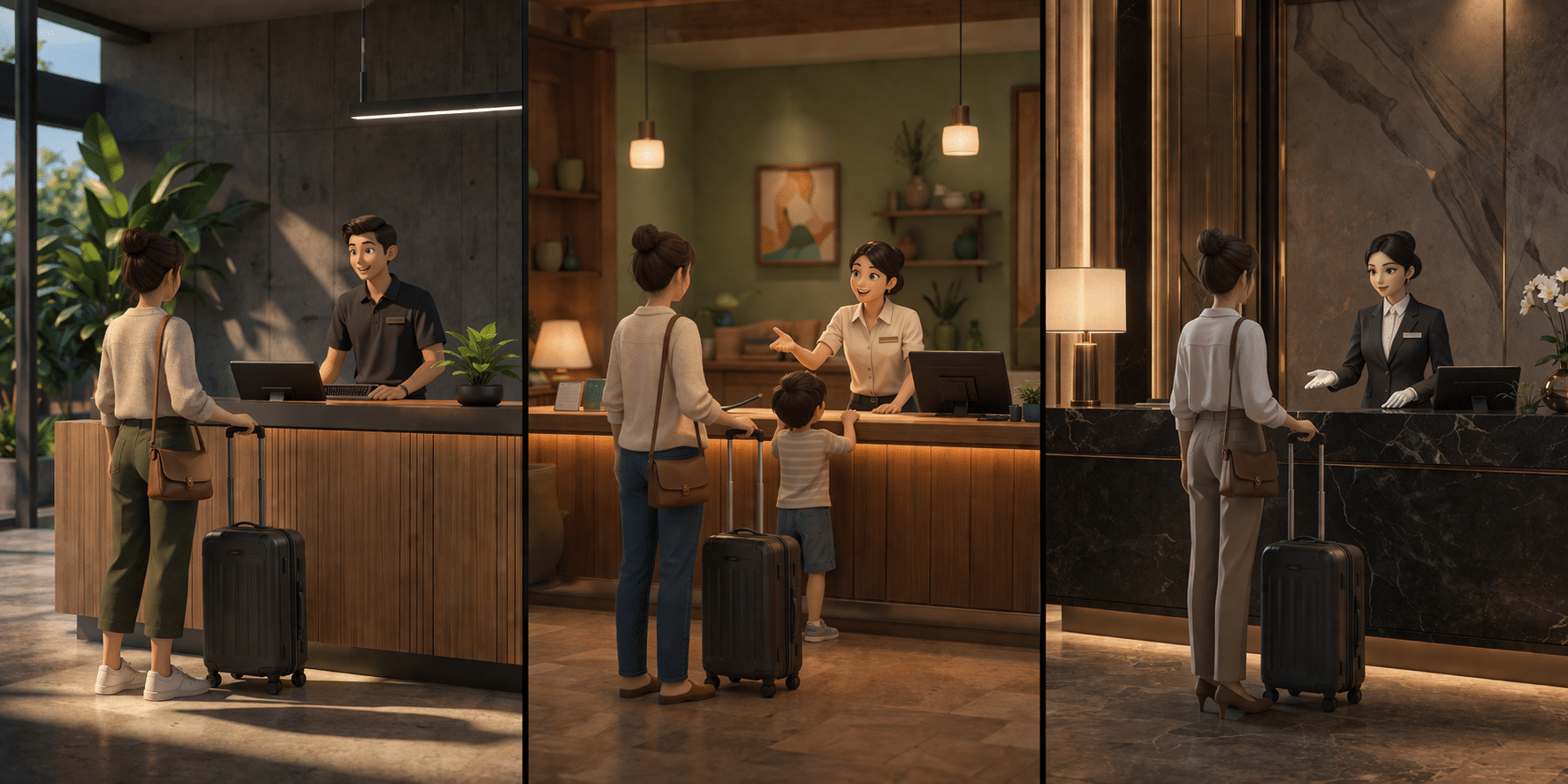
Service scenarios cannot be reused across brands with minor edits. A warm welcome at a midscale property is structured differently from a warm welcome at a premium property. The language, the sequence, the level of personalisation expected: they are not the same. Scenario writing in a brand-led build means writing distinct scripts for each brand, anchored in that brand’s service codes. The shared engine ensures the scenarios are assessed consistently. The brand layer ensures they feel authentic. This is where the gamified training approach proves its value. A traditional eLearning module can describe the difference between brands. A simulation lets staff practise the difference in context.
The risk of brand-led design is losing pedagogical coherence. If each brand’s training is too autonomous, the group loses the ability to compare performance, set consistent standards, or scale improvements across the network.
The shared engine prevents this. Every brand uses the same scoring logic, the same assessment thresholds, the same chapter structure, the same certification criteria. A general manager comparing Ibis results with Novotel results is looking at the same pedagogical framework. The experience was different. The measurement is identical.
This consistency is what allows a multi-level leaderboard to work. In the Accor project, the leaderboard runs at three levels: individual scoring, hotel-level ranking inside a country, and regional performance comparisons. When Novotel launched a lucky draw campaign for top-performing hotels, the three-level structure was already in place to support it.
Accor partnered with Emeraude Escape to build a 3D training experience spanning four brand segments: Ibis, Ibis Styles, Novotel and Pullman. Each brand received its own immersive environment, with distinct visual identity, materials, atmospheres and service scenarios, all running on a shared engine with consistent gameplay mechanics and pedagogical structure.
The build covered four modules (Housekeeping, Reception, Food & Beverage, and Essentials for All) totalling 12 hours of training. Brand and marketing teams were involved throughout to protect each brand’s identity inside the gameplay. The incentive structure operated at three levels: individual scoring, country-level hotel leaderboards, and regional performance views.
87% of learners gave the highest possible satisfaction score. The training deployed in 20 languages, integrated with Docebo LMS, and supported continuous refinement through weekly performance reporting.
Every multi-brand training project starts with the same architectural call: build separate, or build on one engine. The answer shapes the cost structure, the maintenance burden, the pedagogical consistency, and the speed at which new brands can be added later. Getting that decision right in the first weeks is worth more than any amount of refinement later. Explore how Emeraude Escape designs for multi-brand groups on our Case Studies page.
Get a personalized demonstration by one of our game design experts.



Mystery game
Congrats!
An error has occurred
Welcome {name}
Keep an eye on your email {email}, you will receive something from us in the next few hours.