08/06/26
Expert opinion
SCORM vs xAPI: Which Standard to Choose for Your Digital Training
Corporate training has a reputation problem. Slide decks pile up, videos play to half-empty rooms, and knowledge evaporates within days. Yet the organisations getting the best results from their L&D investment are doing something fundamentally different: they are replacing passive content consumption with active, game-based experiences. Custom training games (digital escape rooms, open-world metaverses, simulation games, and virtual scavenger hunts) are changing how companies onboard new hires, develop their leaders, and equip frontline teams to deliver exceptional customer experiences.
Below is a guide to what custom training games look like across three of the most critical learning and development priorities in any organisation.
First impressions matter. Research shows that 94% of employees would stay at a company longer if it invested in their career from the outset. Yet many onboarding programmes are still built around lengthy manuals, compliance videos, and box-ticking exercises that fail to inspire new hires or connect them emotionally to the company culture.
Custom onboarding games change this dynamic entirely. A Digital Escape Room, for example, can guide a new employee through the company’s history, values, and key processes by embedding that information inside puzzles they must solve to progress. Rather than reading that the organisation was founded on a commitment to sustainability, the player discovers it by decoding clues, unlocking hidden rooms, and collaborating with teammates in real time.
A Virtual Scavenger Hunt is another powerful format for onboarding. New hires are sent on a digital journey across different departments, tools, and systems, meeting key contacts, learning workflows, and absorbing culture through exploration rather than instruction. Luxury brand Dior, for instance, uses a fully branded gamified onboarding experience to immerse new retail staff in the maison’s heritage, product knowledge, and service standards from day one.
For remote or globally distributed teams, an Open-World Metaverse onboarding experience allows dozens or even hundreds of new joiners to explore a custom virtual campus simultaneously, attend live briefings, complete missions, and build relationships, all without a single flight or conference room booking.
The common thread across all these formats is active participation. New hires are not talked at, they are invited in.
Leadership training is one of the hardest learning challenges to design well. The skills that define great leaders (empathy, strategic thinking, communication under pressure, the ability to manage change) are not easily transferred through a workshop or an e-learning module. They need to be practised.
This is where Simulation Games come into their own. A custom leadership simulation places participants inside realistic, pressure-tested scenarios: a product launch that goes off-script, a team conflict that needs mediating, a board that needs persuading. Players must make decisions, work through consequences, and reflect on their choices, all within a safe digital environment where failure is a learning tool rather than a career risk.
Digital Cluedo-style games are increasingly used for change management and culture programmes. Teams must work together to piece together clues about an organisational challenge (an underperforming division, a struggling product line), requiring them to collaborate, question assumptions, and reach shared conclusions. The investigative format naturally builds the analytical and consensus-building muscles that leaders need.
For high-potential leadership cohorts, a Digital Championship format, where teams compete across a series of strategic challenges, creates the kind of healthy competition and performance pressure that reveals how individuals behave under stress. This gives both participants and L&D teams rich, data-backed insight into strengths and development areas.
Importantly, all of these experiences can be tracked and measured. Custom back-office dashboards capture completion rates, decision patterns, time-on-task, and score progression, giving HR and learning leaders the KPI data they need to demonstrate impact and personalise follow-up development.
In retail, luxury, and service-driven industries, customer experience training is mission-critical. A single poorly handled interaction can cost a brand a loyal customer. In the age of social media, it can cost them thousands more. Yet traditional customer experience training (role-plays with a trainer, scripted scenarios on a screen) rarely replicates the complexity, pace, and emotional texture of real interactions.
Custom Serious Games built around the selling ceremony, clienteling, and after-sales service allow retail associates to practise high-stakes customer scenarios in a fully branded, immersive environment. Lancôme uses gamified product training games so that beauty advisors can explore ingredients, master the consultation process, and handle objections, all before they step onto the shop floor. The result is faster, deeper engagement with the content and measurably stronger performance in the field.
Interactive Video is another format gaining traction in customer experience training. Players watch realistic service scenarios unfold and must make choices at key decision points: how to greet a VIP client, how to handle a complaint, how to cross-sell without pushing. Each choice leads to a different branch of the story, making the consequences of their decisions immediately visible and memorable.
For global retail brands with multilingual teams, these games can be fully translated and localised ensuring that quality and consistency of training is maintained across every market.
The word ‘custom’ does significant heavy lifting here. Off-the-shelf training games can demonstrate the mechanics of gamification, but they cannot embed your brand identity, your specific products, your values, your processes, or your culture. A generic escape room about workplace safety is forgettable. A branded game set inside a virtual version of your own warehouse, featuring your own safety protocols and your own team’s names, is not.
The best custom training games are designed around the client’s DNA from the first line of the brief to the final pixel of the interface. They are built in-house by multidisciplinary teams of game designers, illustrators, developers, and learning specialists.
The organisations that are winning the talent war (attracting, engaging, and retaining exceptional people) are the ones that treat training as an experience worth designing, not a box worth ticking. Custom training games are how they are doing it.
What types of corporate training are best suited to a gamified format?
Gamification works particularly well for training that requires behaviour change, knowledge retention, or the practice of interpersonal skills: onboarding, compliance, customer experience, sales techniques, leadership development, change management, and culture programmes are all strong candidates. It is especially effective where learners are geographically dispersed, where engagement with traditional formats is low, or where training content needs to be delivered at scale across multiple markets and languages.
How long does it take to develop a custom training game?
A fully custom corporate training game can typically be delivered in under two months from brief to launch. This timeline depends on the complexity of the format chosen and the speed of feedback and approval cycles on the client side. Simpler formats such as quiz-based games or digital scavenger hunts can move faster; more complex open-world metaverse experiences or multi-branch simulation games may require additional time.
How do you measure the effectiveness of a custom training game?
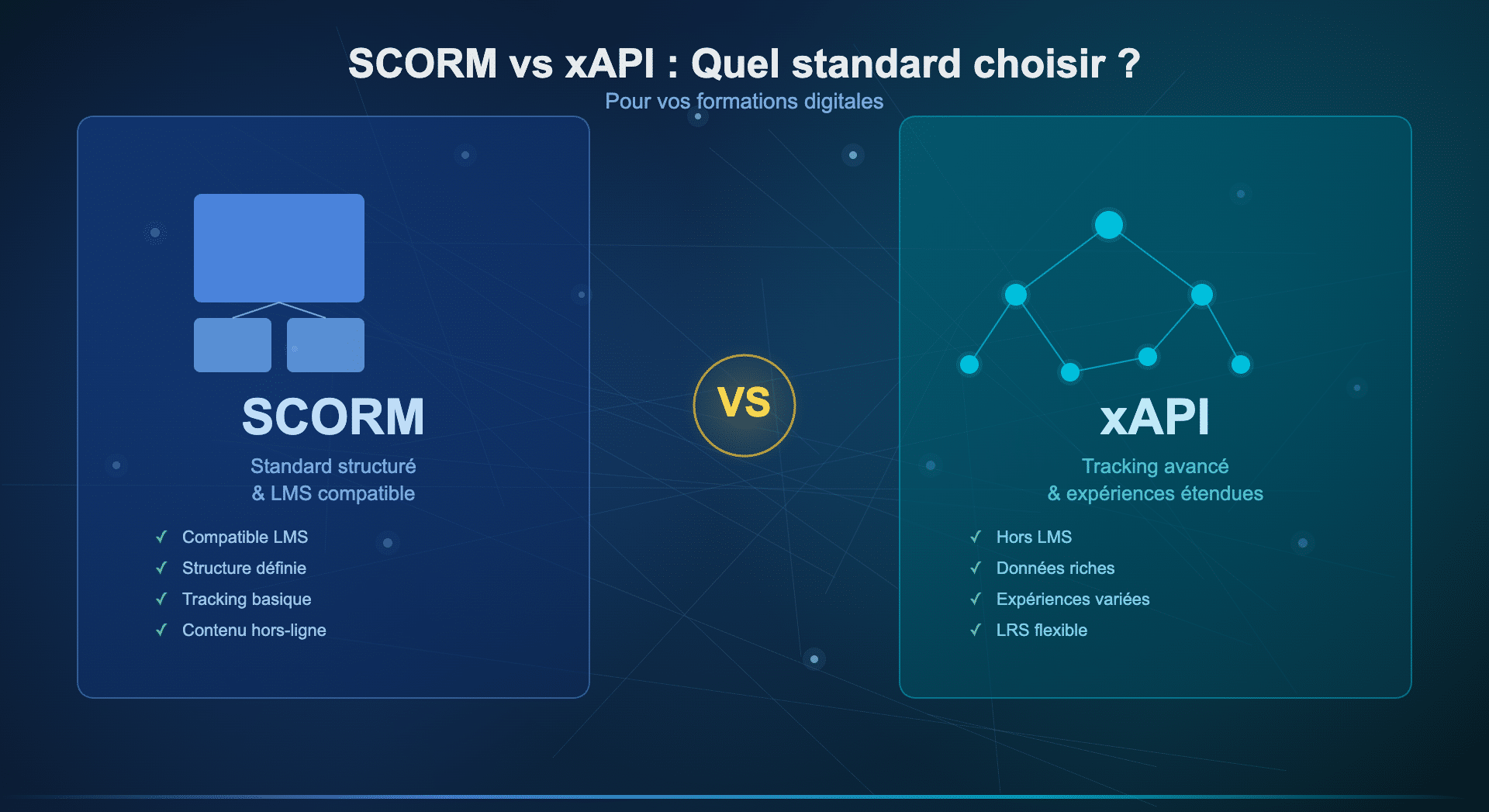
Effectiveness is measured through a combination of engagement data and learning outcomes. On the engagement side, custom back-office dashboards track completion rates, time-on-task, drop-out points, and leaderboard performance. On the learning side, progress through scenarios, quiz scores, decision patterns, and knowledge-check results are captured and fed directly into your LMS via SCORM 1.2, SCORM 2004, or xAPI. This data allows Learning and Development teams to identify knowledge gaps, personalise follow-up support, and demonstrate measurable ROI to business stakeholders.
What is the difference between a Serious Game, a Digital Escape Room, and a Simulation Game for corporate training?
These terms describe different game mechanics, each suited to different learning objectives. A Serious Game is a broad category encompassing any digital game designed with a primary educational or training purpose. It can take many forms. A Digital Escape Room is a specific format in which players must solve a series of puzzles within a time limit to progress through virtual rooms or unlock content; it excels at embedding factual knowledge and fostering team collaboration. A Simulation Game reproduces real-world situations as closely as possible (players make decisions, see consequences, and iterate), making it the format of choice for developing judgment, leadership skills, and complex procedural knowledge. The right choice depends on your learning objectives, audience, and desired level of complexity.
Get a personalized demonstration by one of our game design experts.


Mystery game
Congrats!
An error has occurred
Welcome {name}
Keep an eye on your email {email}, you will receive something from us in the next few hours.