
09/03/26
Expert opinion
Corporate Training Games vs E-Learning: Which Is More Effective?

Choosing a training approach for retail teams can feel deceptively simple. Most formats promise engagement, efficiency and results. Yet the real impact of that choice often only becomes visible later through low completion rates weak recall or training that never quite translates into confident customer conversations.
The right approach supports how retail teams actually work. It fits into short moments, adapts to different learners and helps people remember what matters when they are engaging with customers. To make that choice well leaders need to consider one factor that is often underestimated in training design: emotion.
In corporate training games, emotion is not a creative extra. It is a practical lever that shapes attention, memory and behaviour. In retail it plays a second equally important role. It is also what sales teams are ultimately trying to create in the people they speak to.
In many retail environments sales is not simply about transmitting information. It is about helping customers imagine how they will feel. Products are translated into stories, ideas and emotions that create desire and connection.
This is why emotion matters twice. First in training where it helps people pay attention memorise and remember. Then in sales where it helps people pass that feeling on.
As Sophie Robinson, Global Training Manager at L’Artisan Parfumeur, explains when speaking about fragrance sales.
“In fragrance you are not just selling a product. You are creating a dream. You are telling a story that helps someone imagine how they will feel.”
That storytelling ability does not begin on the shop floor. It begins with training. Sales teams cannot create emotion for others unless they have first connected to it themselves.
Learning science consistently shows that emotion plays a central role in how the brain processes information. Emotion influences attention and attention determines what is encoded into memory.
A review published in Frontiers in Psychology on the influence of emotion on learning and memory shows that emotionally salient experiences are more likely to be encoded deeply and retained over time than neutral content.
This explains a common training challenge. Content that is accurate but emotionally flat is easy to skim and easy to forget, while content that creates recognition or meaning is more likely to stay with the learner.
In Serious Games for corporate e-learning this distinction is critical. Training that feels like information delivery may be completed but often fails to surface later in real interactions. Training that creates an experience is more likely to be remembered when it matters.
Organisations choosing a Serious Game partner are not buying content. They are choosing how learning will be experienced, remembered, and carried into real customer interactions.
Instead of starting with what needs to be explained, the design process begins with what needs to be recognised. What decisions does a sales associate face. What moments require confidence. What details help a story come alive.
Corporate training games are then built to reflect those moments. Storytelling provides context. Visual environments support imagination and memory. Interaction allows learners to explore rather than passively consume information.
Emotion is designed through focus and pacing. Rather than overwhelming learners with information one meaningful idea is explored clearly. This creates what many learners describe as a moment of insight.
This approach works because it matches how people actually learn at work. When emotion and sensory experience are designed into training by a game based learning agency, information is remembered as experience rather than facts. That makes it easier to recall under pressure and use naturally in real conversations.
Instead of memorising scripts, people build confidence and adapt their storytelling to the customer in front of them.
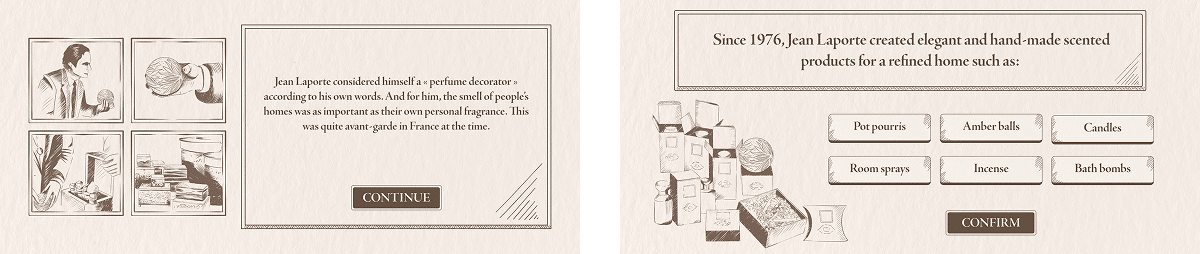
This approach shaped the design of a corporate training game developed to support a product launch at L’Artisan Parfumeur. The objective was not simply to teach product specifications. It was to help sales teams feel connected to the brand’s heritage so that the story behind each fragrance became natural to share rather than something to recall under pressure.
Instead of a traditional e-learning module, the training was designed as an immersive experience set inside a Parisian apartment. This choice was deliberate.
The apartment setting mirrored the emotional world of the brand, placing learners inside a familiar and evocative environment rather than a neutral learning interface. As learners moved through rooms, they encountered inspirations, raw materials, and creative stories in context, allowing emotion to anchor information in memory.
Robinson explains why this mattered for learning and sales performance.
“We wanted people to reconnect with the brand, not just learn about a product. When you understand where the story comes from, it becomes much easier to tell it.”
The training focused on creating small moments of emotional recognition rather than exhaustive explanation. These moments acted as memory triggers.
One detail, one image, or one story became something learners could recall later and use confidently in conversation. This emotional design had a clear impact. Learners did not just complete the module, they remembered it.
The experience achieved a completion rate close to 95 percent, which is significant in retail environments where training often competes with daily operational pressure. Feedback showed that the aesthetics and narrative structure made the training feel meaningful rather than mandatory, increasing both engagement and recall.
Crucially, the emotional connection created during training gave sales teams something they could pass on. Instead of repeating technical information, they shared stories that helped customers imagine how a fragrance might make them feel. Emotion became the bridge between learning, memory, and the customer experience.
What makes this approach powerful is not only how it supports learning but how it supports sharing.
When training creates emotional connection it gives sales teams something to pass on. A story, a detail, a feeling. This is how knowledge moves from training into conversation. From a learning perspective emotion strengthens memory. From a sales perspective it strengthens storytelling. The two are directly linked.
As Virgil Loisance, founder of Emeraude Escape, explains.
“Training only works when it creates something people want to pass on. Emotion turns knowledge into story and story is what travels.”
This is where game based learning becomes particularly effective in retail. It allows training to mirror the experience sales teams are expected to create for customers.
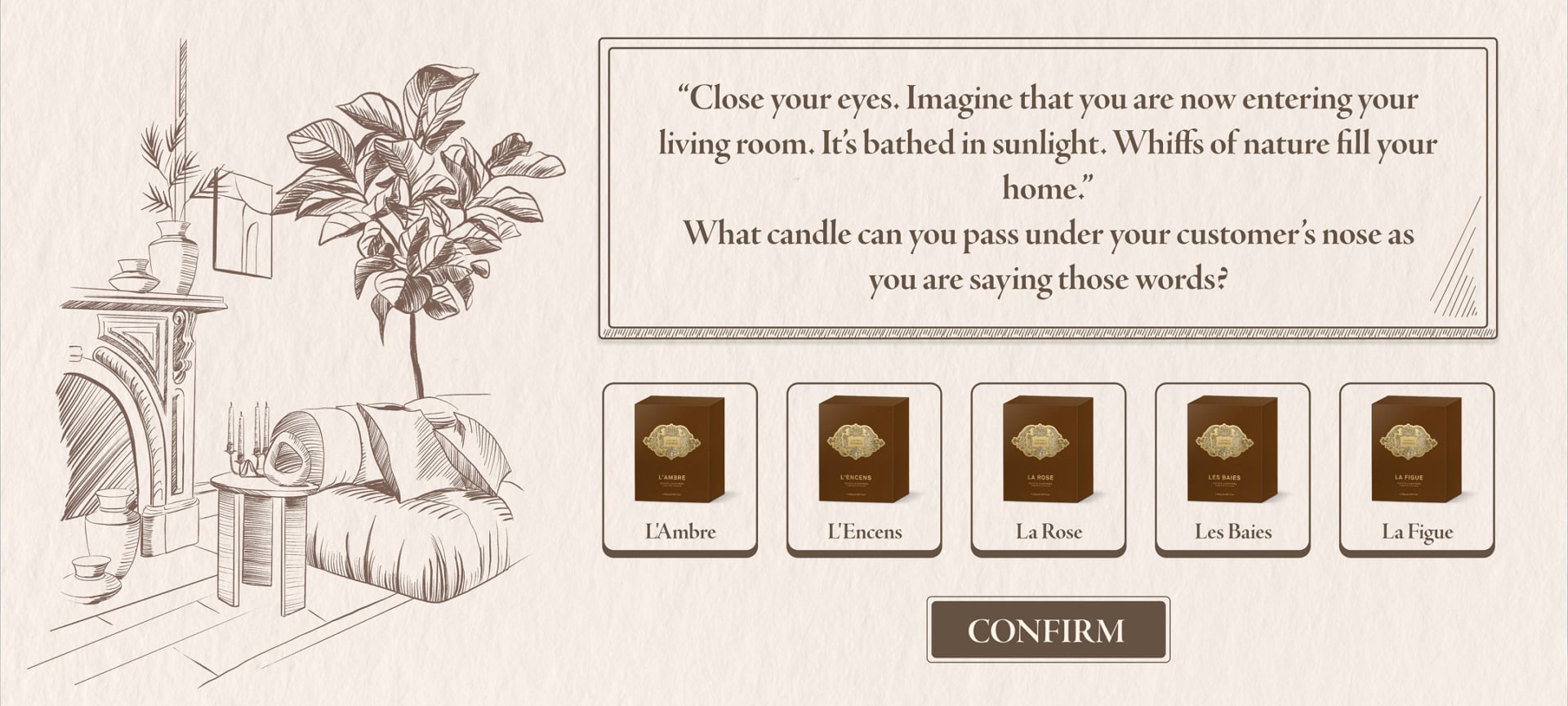
Retail brands operate through tone identity and emotional connection. Generic training formats often struggle to reflect these nuances. Custom training games allow learning to be designed around a specific brand context. Language settings and scenarios mirror the world sales teams operate in. This relevance supports emotional engagement recall and confidence.
Loissance adds:
“People do not remember modules. They remember meaning. Custom training games allow learning to feel real rather than theoretical.”
This is why custom training games consistently outperform one size fits all approaches in customer facing roles.
For leaders emotion is not a soft consideration. It is a practical one. Training that helps people feel something is more likely to be remembered. Training that helps people remember is more likely to be used. Training that is used is what ultimately shapes performance. This is particularly true when storytelling and human connection are central to success.
Emotion is the thread that connects effective training to effective sales. In corporate training games it helps learners pay attention memorise and remember. On the shop floor it helps sales teams translate products into stories ideas and feelings that resonate with customers. The difference between average and high performing training programmes is not creativity. It is whether the learning experience changes behaviour under real conditions.
How do sensory experiences in training improve sales conversations?
Sensory experiences such as visual environments, narrative settings, and interactive exploration help learners form mental images and associations. These associations make it easier for sales teams to describe products in vivid, engaging ways that customers can relate to.
What does emotional storytelling change compared to traditional training?
Traditional training focuses on accuracy and coverage. Emotional storytelling focuses on meaning and confidence. This shift helps teams move from repeating information to sharing stories that feel natural and convincing.
What role does game based learning play in emotional engagement?
Game based learning encourages exploration and discovery, which increases attention and curiosity. This active involvement helps learners remember key ideas and apply them more confidently in real interactions.
Get a personalized demonstration by one of our game design experts.



Mystery game
Congrats!
An error has occurred
Welcome {name}
Keep an eye on your email {email}, you will receive something from us in the next few hours.