
09/03/26
Expert opinion
When Should You Work with a Game-Based Learning Agency?

Corporate training games outperform e-learning when behaviour change is the goal. Putting people inside realistic scenarios where decisions carry consequences produces measurably stronger outcomes than passive content delivery. For getting information across to large workforces quickly, traditional e-learning still does that job well.
Corporate training games — often called Serious Games or simulation-based learning — are interactive digital experiences where employees make real decisions inside realistic scenarios, and see the consequences play out.
The difference from traditional e-learning is not cosmetic. A manager preparing for a restructure announcement does not need another slide deck explaining communication best practice. What they need is to have attempted that conversation already, in a low-stakes environment, and to have seen where it went wrong. That is what a well-designed corporate training game provides.
Traditional e-learning delivers content. Learners watch, read, and click through to the next screen. It works well for certain objectives. But when the training goal involves changing how people behave under pressure passive formats have a structural limitation that game mechanics and scenario design are built to overcome.
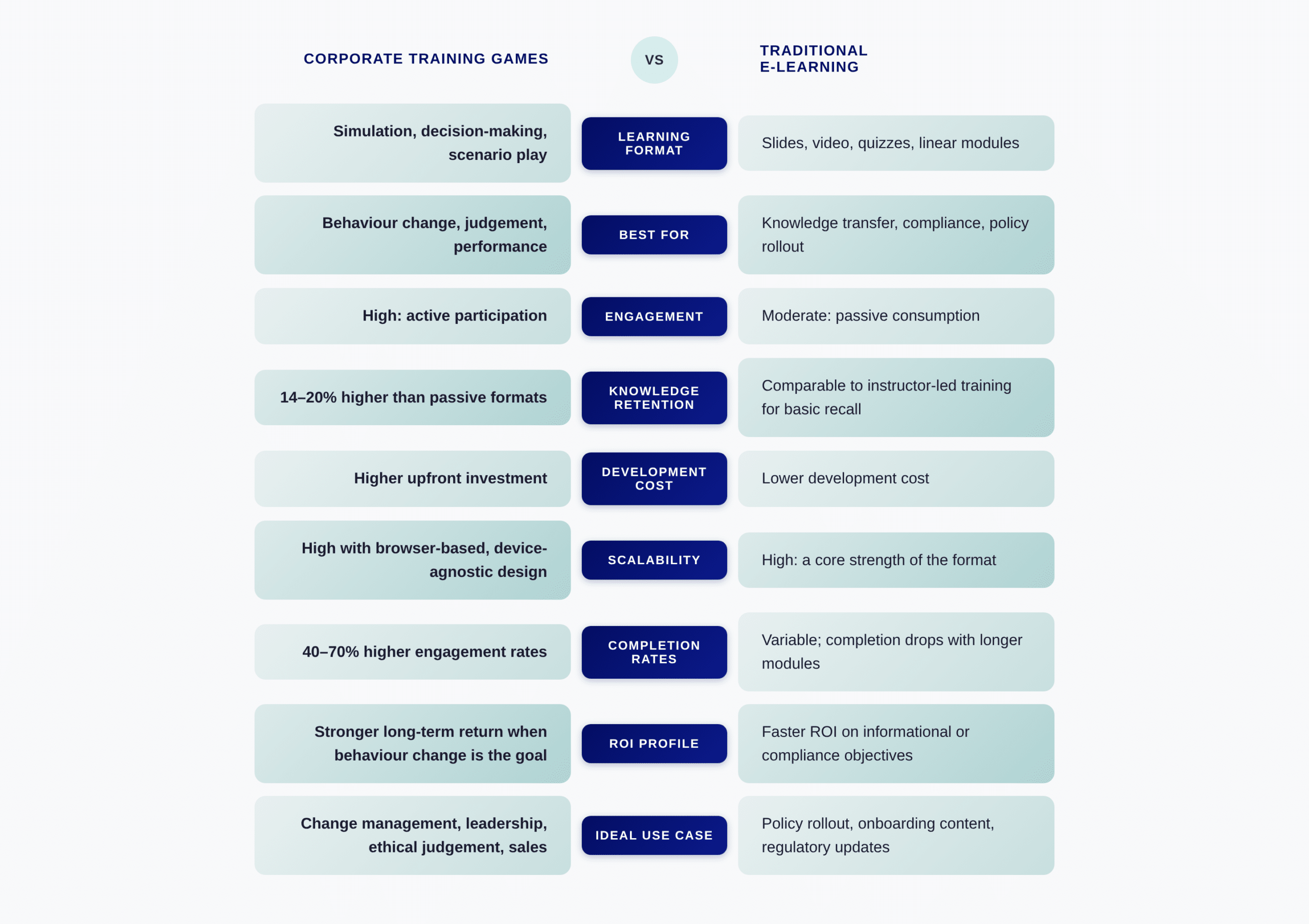
The evidence for corporate training games is solid. A 2024 review in Computers & Education looked at more than 8,000 learners and found that business simulations improved motivation, learning quality and on-the-job performance.
A separate study in Personnel Psychology found something equally important: employees who trained through simulations remembered more weeks later than those who completed standard digital courses. Kapp’s research on interactive learning formats found engagement rates running significantly higher than passive alternatives, with most learners preferring them. The common thread is this: when training involves making decisions and seeing consequences, people retain more and perform better.
Traditional e-learning is not the wrong tool, it is just the wrong tool for certain jobs. Communicating a policy update, onboarding staff to a new system, completing compliance documentation before a deadline are tasks e-learning handles well. The problem arises when organisations use it to change how people behave, not just what they know. Understanding what a good decision looks like and being able to make one under pressure are two different things. E-learning can cover the first. Corporate training games are built for the second.
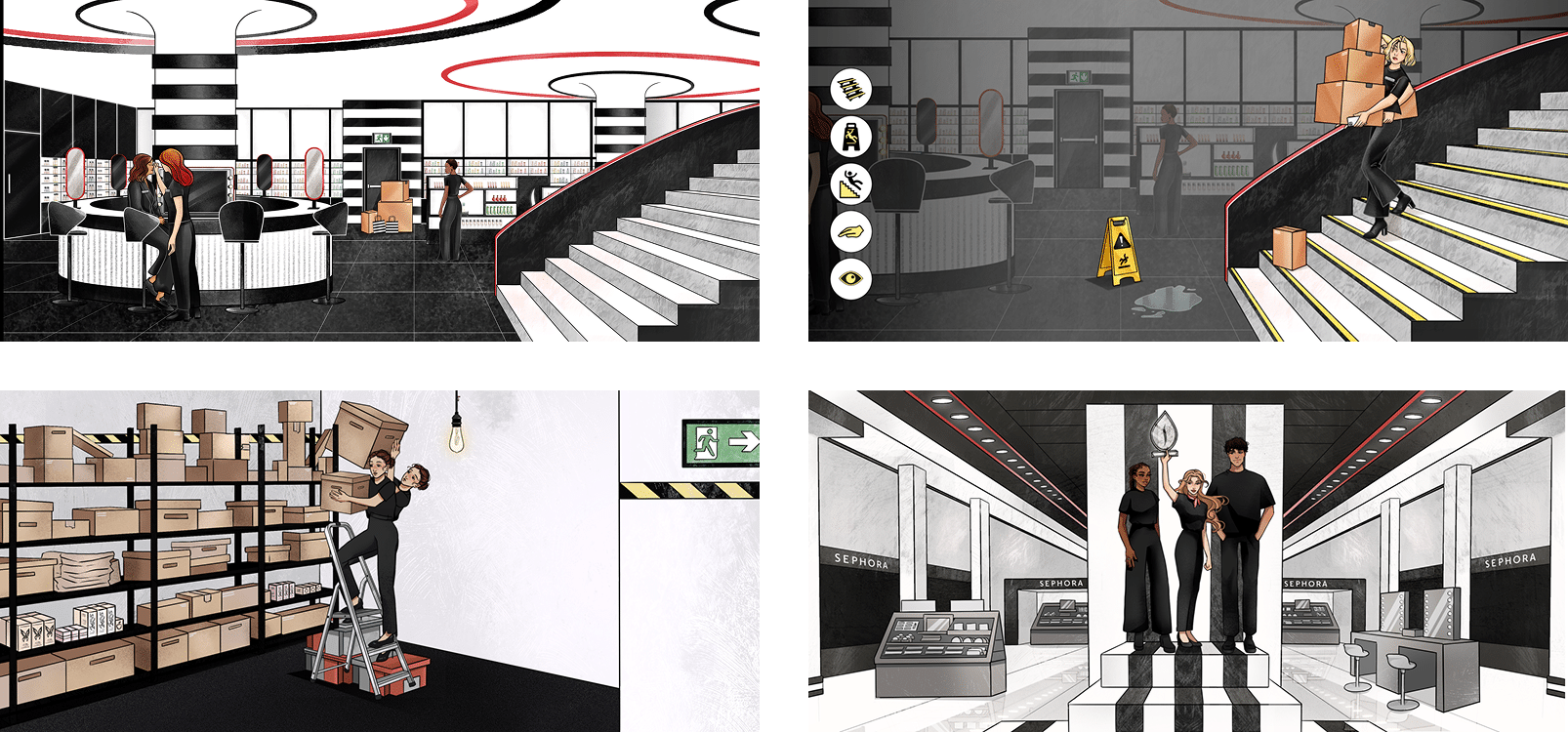
Change management is arguably the strongest argument for corporate training games in enterprise learning today, and it is underused. Organisational change does not fail because employees lack information. It fails because they are not sure what is expected of them, and may not have the interpersonal skills to navigate the disruption. None of those gaps are addressed by an e-learning module explaining the stages of a transformation.
What does address those gaps is practised experience. A manager who has already navigated a simulated conversation with a resistant direct report — made a poor choice, seen it go wrong, reflected on it, and tried again — enters the real conversation in a fundamentally different state than one who watched a video about managing resistance.
Emeraude Escape builds scenario-based corporate training games designed specifically for this kind of transformation context. Their modules place learners inside realistic change scenarios tailored to the organisation’s own culture, messaging, and change narrative. A manager at a company undergoing a structural reorganisation does not practise generic change management skills — they practise this change, with this team dynamic, responding to the kinds of pressures their specific role will face.
That level of contextual specificity is not achievable with off-the-shelf e-learning. It is what separates a training programme that employees complete and forget from one that actually shifts behaviour during a transition.
One of the clearest arguments for corporate training games over e-learning is what happens when the stakes rise.
In roles where a wrong call has real consequences — a transformation lead communicating redundancies, a department head managing a resistant team through a process overhaul, a senior manager responsible for sustaining new behaviours after a merger — knowing the right answer in theory is not the same as being able to execute under pressure.
Roediger and Karpicke’s research in Psychological Science showed that retrieving and applying knowledge under pressure encodes it far more durably than reading or watching ever does. That is the mechanic corporate training games are built on — the learner has to make a call, and something happens as a result. It is a fundamentally different cognitive experience from clicking through a module, and the retention data reflects that.
Organisations going through change don’t always have the opportunity to pull employees into a room for face-to-face training. Global workforces, multiple time zones, and the practical limits of manager bandwidth all make centralised delivery impractical.
Corporate training games built on browser-based platforms address this. Emeraude Escape’s platform, for instance, requires no downloads, runs on any device, and supports unlimited multilingual versions, meaning a change management programme can be deployed consistently across regions without compromising the quality or specificity of the experience. That consistency matters during transformation, when mixed messages across offices can fuel uncertainty.
Are corporate training games the same as gamification?
No, and the distinction matters practically. Gamification adds game mechanics — points, progress bars, leaderboards — to existing content formats. Corporate training games are purpose-built simulations where the structure of the game is the learning mechanism itself. Gamification can increase engagement with passive content. Serious Games change what people do. For change management, where rehearsal of real behaviour is the goal, the difference between the two is significant.
How long does it take to build a corporate training game?
It depends on complexity, but the timeline is shorter than most organisations expect. Emeraude Escape delivers fully customised programmes in under two months. The modular structure also means that as a transformation evolves — new milestones, revised messaging, additional teams — the programme can be updated without rebuilding from scratch.
Which organisations benefit most from corporate training games?
Organisations managing large-scale transformation programmes, those with distributed or multilingual workforces, and those where poor decision-making carries material cost are the strongest candidates. Financial services, professional services, healthcare, and technology companies have been early adopters, but the case for corporate training games applies wherever the gap between knowing the right answer and being able to execute it under pressure is costing the business.
Get a personalized demonstration by one of our game design experts.



Mystery game
Congrats!
An error has occurred
Welcome {name}
Keep an eye on your email {email}, you will receive something from us in the next few hours.